Thursday, 28 March 2013

The Value of Welsh Newspapers Online


welshnewspapers.llgc.org.uk

I recently attended and spoke at an expert seminar prior to the launch of Welsh Newspapers Online at the Pierhead in Cardiff.

The seminar was excellent and the launch went like a dream. The folks at the National Library of Wales have done a great job with this newspaper resource which will deliver
1,000,000 pages of Welsh history to 1910 online, and free of charge.

See also this video explaining the Welsh Newspapers Online

One speaker stood out from the array of great talks on that day. Jim Mussell gave an entrancing discourse on what newspapers mean and his insight into the promise of novelty wrapped in familiarity that newspapers engage in. The whole of his talk is available at his excellent blog: http://jimmussell.com/2013/03/13/parsing-passing-events/ but I quote the part which changed my perceptions of newspapers the most:

"The appeal of the newspaper is predicated on the promise of novelty, but the newspaper itself consists of a complex set of recurring forms. Repetition is key to the way newspapers operate and, because they are serials, is encoded into their DNA.
All serials create a sort of contract between publisher and reader: publishers attempt to anticipate the demands of their readers by giving them more of what they have already demonstrated they want; readers repeatedly spend their money on the understanding that they will not be disappointed. Each issue of a newspaper attempts to narrate the present, assimilating events into a set of pre-existing structures that assert the individual publication’s identity.
In other words, the single issue does not exist in isolation, but re-presents, through its form, the issues that precede it. Newspapers might be oriented towards the present and contemporary, but they do so by establishing continuity with the past and promising it into the future."


I had the pleasure to work with Jim on the Nineteenth Century Serials Edition project and it was fascinating to receive his insights on this day.

Value and the Newspapers

Here is the text of my short talk I gave to end the expert seminar.

The Welsh Newspapers Online is an excellent interface and resource. So my query is - What does it deliver to us that shows its tangible values to the community of beneficiaries?

When I think about Value I want to consider this from a few perspectives that can be balanced to find a holistic overview of what has been achieved:


The benefits to us as a research community – our ability to ask research questions and to engage with the materials in fresh ways. But in some ways this efficiency and effectiveness argument is now very much a lowest common denominator for digitisation projects – how do we move beyond the efficacy argument to deeper more resilient benefits that answer the “so what” questions of wider public concerns.


The benefits this innovative opportunity provides in terms of the ability to not just mine the

content, but to genuinely generate meaning and understanding that is fresh and will appeal to a much wider constituency than just the current deeply committed research community. The planned opening of the API to the Welsh Newspapers Online will deliver real innovative use of the data and by opening up the data it allows the community to have a stake in the data not just a web front end. It also allows for the opening of mobile platforms to access this information, anywhere, anytime…

And so as we reach out to refresh the audience for these materials we consider the community and social benefits of the newspaper collection online. These materials could be used in schools and from perspectives of local history, family history and diaspora interests of course. When I did the original strategy consultancy for Andrew Green's vision of the Theatre of Memory all those years ago we identified a huge number and range of communities that could be served by the NLW’s collections – drama, music, poetry, sport, religion, science, engineering, food and language to name just a few. There are opportunities to solidify a sense of place and time and a personalized narrative and history reflected in the national and local stories contained in the newspapers.


And let’s not forget the economic value of this resource being free at the point of use for everyone, everywhere. I cannot emphasise how valuable these cultural resources are to enable the Small Smart Countries agenda. This has benefited places like Singapore so much for instance and is referenced in the National Library of Scotland's Thriving or Surviving strategic report. The digital allows smaller collections to compete on a more equal footing with more monolithic collections. The folks at the National Library of Australia have a huge amount of traffic and attention to their newspaper collections because it is free and they claim also that the British Library’s charging mechanism for newspapers is driving users their way.


The public want content – where they are, when they want it and are agnostic about the source. If we want their attention and thus their support then we have to get our data to them with as little friction as possible. We need demonstrable attention and engagement from our communities as a means of driving fundraising from individuals and foundations.

So when we trade in digital content it is not just a straight line commercial ROI but we also trade in intangible benefits such a national pride, smarter better informed communities and pushing technological leading edges that help us to build a strong economy and improve the quality of life for our citizens.

In short, when I look at newspaper digitisation the success is in a threefold relationship between having enough high quality content, having an excellent infrastructure to hold it and engaging with a wide audience of users.


I believe the NLW with this newspaper project has got the balance right – it’s like the thought experiment I use when thinking about digital resources: is the value in the wine, the glass or the drinking?
Clearly all three have to exist and balancing them is very difficult.


So, I hope this evening we will raise a glass in celebration of this new, innovative and FREE newspaper resource. And, as we do, we can consider the quality of the wine, the joy of the drinking and that unsung hero, the glass.


Let’s applaud our friends and colleagues at the National Library of Wales for this achievement.


A last note on a personal hero

The launch of the Welsh Newspapers Online also saw somewhat of a last hurrah for the outgoing Librarian of the NLW, Andrew Green, who has now retired. Andrew is a very modest man and probably will not thank me for relating this, but I consider him the most passionate, clever, kind, thoughtful and visionary national librarian I have worked with in the last 15 years.

He has the undying adoration of his team at NLW and I have found him an astoundingly supportive person to work with. We sat on the Legal Deposit Advisory Panel together and I have been commissioned to do various consultancy gigs at NLW plus I have always been happy to get advice and support for my various endeavours from Andrew and the NLW team.

Andrew has a deep passion for libraries and for Welsh culture and heritage, but he also has a strong strategic sensibility and pragmatic understanding that has enabled him to work some real magic at the NLW and particularly in their digital offerings. It is no accident that the NLW is the only national library to have a Chair in Digital Collections...


Tuesday, 12 March 2013

World class digitisation in Sweden

I recently attended the Digidaily newspaper project review at the National Archives department for digitization Media Conversion Center (MKC) in Fränsta, Sweden. I describe here some of the secrets of the success I observed and also my review and recommendations for the future directions suggested by this ground breaking project.

It is a privilege of my working life that I get to see behind the scenes at many great memory organisations the world over, both as an academic and as an advisor. This privilege is made even more pleasurable when the people you are working with are highly professional, smart and welcoming.

Such was the experience of being an external expert on the 6-7 February 2013 final seminar and review at MKC in Fränsta for the Digidaily project. Fränsta is not the easiest place to visit with 2 flights and a 1 hour car journey but it is certainly worth the visit if you want to see one of the world's finest digitisation production houses.

The folks at MKC (who did the digitisation) and their colleagues in the National Library of Sweden (KB) are wonderful hosts. They also have the unique ability to listen intently to all advice given and never once become defensive if there is a negative comment or constructive criticism. They just absorb it all, ask smart questions so they understand what is needed and then get on with making their processes better. This is something I rarely see and is a culture inculcated by the management at both MKC and the KB that is to be applauded. These folks really know how to collaborate.

Investigating newspaper segmentation
Among the invited guests was an old friend and fellow invited external expert, Edwin Klijn (The NIOD Institute for War, Holocaust and Genocide Studies and the former project manager at Koninklijke Bibliotheek, the Netherlands). Edwin is always a pleasure to work with and his experience has been absolutely essential to us both being able to give a well rounded and supportive assessment for Digidaily. It was also great to meet colleagues from Norwegian and Finnish newspaper digitization projects and to meet with the Swedish National Librarian, Gunilla Herdenberg, the National Archivist, Bjorn Jordell, members of Digisam and also Isobel Hadley Kamptz from the Swedish Digitizing Commission.

Getting Right to the Point

My assessment of the Digidaily project is that the production house, the quality assurance, the digitisation workflow, the very high throughput and the balance of costs against productivity to deliver such a high standard of colour imaging of newspapers is truly world class and amongst the best I have ever witnessed.
The levels of achievement that I saw in this project review astounded me - the teams at the KB and MKC have exceeded even my high expectations for their excellence. I know I am gushing here, so let me tell you why this is impressive and also that there is inevitably more to do.


The Swedish Secrets of Success

1. Culture. They have the right culture for success. It is built upon sharing ideas, co-operation, listening and working very hard to be the best. As is often said get the right culture and good performance will follow and from there great results. MKC and KB have one of the best working environments for digitisation I have seen - they have copious space for layout and preparation of the originals, they have an excellent quality assurance suite, they have great ergonomics on the scanning equipment. But most of all there is an attitude of respectful team-working, of pursuing best practice, of working hard at augmenting their processes and workflows and this underpins their success.

2. Costs. They know exactly how much everything costs - there is not a process or a step along the way that MKC and KB have not accounted for and have not placed a cost against. This transparency has allowed them to focus on the right areas where cost savings can be achieved through efficiency gains and to also support investing in those areas where the value is most apparent. I have always been impressed with the high volume throughput achieved at MKC despite the very fragile materials they are working with (on average this about 90-100,000 images per day). Usually one would assume working with fragile and hard to handle originals such as newspapers (see images below) would push the costs up and certainly the preparation costs are higher because of these originals. But the Digidaily project has optimised its workflows to such an extent that they really surprised me with their price per page. The costs are incredibly low for the quality and standards being achieved.

Varied types and quality of newspaper


Superb preparation facilities at MKC


Varied scanners in use to ensure fastest workflow for
each type of newspaper
Newspaper segmentation.
The different coloured segments show the various articles in the newspaper.
3. Coping with change. The Digidaily project has had to cope with many changes, including: adding segmentation on the page and article level to their workflow, dealing with image quality issues (unwanted artefacts and wavy text), using JPEG2000 as the archival image format and storing everything in colour. Mass digitisation relies on low variation and little change to keep costs down and productivity up. However, the Digidaily took all these specification changes or technical challenges in their stride and still pushed down costs. They used their excellent workflow system to help increase quality by spotting an artefact caused by dust at the point of scanning rather than at image review thus reducing rework considerably. By being flexible but always systematising their decisions they have been able to review, renew and change their working practices to meet new requirements.

4. The 7 wastes mantra. I hope I am not giving away any State secrets at this point but one of the key elements to success was ensuring that they always kept an eye on what they termed the "7 wastes":
  • overproduction, 
  • inventory, 
  • waiting, 
  • motion, 
  • transportation, 
  • rework and 
  • over processing

Future Directions for Swedish Newspapers

It all sounds fabulous, digitising millions of pages in full colour to amazing specifications at a very low cost per page. However, there are a few things missing right now and there are future considerations that are worthy of comment. As a digitisation project and process it is world class, but there are aspects of the activity that have a ways to go to reach the same heady heights.

Access: Right now there isn't a user interface for the Digidaily that is worthy of the original materials or the images and metadata that have been created. There is a huge opportunity here for the KB, to showcase their content to its best effect and to make a wonderful user experience by engaging with the detailed metadata and segmented articles in the digitised newspapers. I pointed to the National Library of Wales newspaper programme which will, in all honesty, not have such sumptuous images as Digidaily, but has an excellent interface that really supports the user and will deliver an open API so that others can also build upon the content. An important next step for the KB and Digidaily is to think about how they want to present their content to their audience.

Segmentation: this is relatively new area that MKC are still getting to grips with in terms of quality assurance and workflow. It is running very efficiently at present but there are some niggles still to be addressed and I am sure MKC will get to grips with these.

Programme not projects: I am recommending also that the KB needs to commit to a longer term programme of digitisation. The cost savings and efficiencies gained in Digidaily will soon be lost if they have to stop, then start, then stop again due to a project led means of funding and managing the digitisation. If the KB can drive towards a programme of work then not only can current efficiencies be secured but I believe that new efficiencies will be achieved as well.

Effectiveness: At times the relationship between MKC and KB has focussed on efficiency and they have worked tirelessly to achieve the most efficient ways of achieving excellent image results. One area I would like to see them give more focus to in the future is the issue of effectiveness. Being effective is about ensuring that those efficient workflows are delivering the most valuable outcome possible. At present the KB have gained some information about their user community and what success looks like for those communities. If they can work more on the desired impacts and evaluate their communities to an even more detailed degree they will be able to deliver the most effective outcomes.

Copyright: I could rant about how daft the IPR/copyright attitude is in Sweden where they basically can't digitise beyond 1862 (YES 1862) without fear of breaching copyright on the basis that someone could live to 90 and then you have to add 70 years on from there. Pretty much everyone else in Europe is finding the 1910's a nice stopping point for copyright works... It's a bonkers situation that Swedish memory institutions find themselves in, but that's probably not something the KB can easily change.


Thank you's

I'd like to thank everyone from MKC and KB for their openness and for just being clever, hard working and passionate about what they do. This independent blog post is my own opinion and thoughts throughout but was written with their permission and I am glad they have let me share some of their "secrets". If you want to know more (and there is more) then get in touch with them and find out from a world leading team how it should be done.

I'd specifically like to thank the following for their support and friendship:-
Mikael Andersson, Stina Degerstedt, Annelie Eriksen, Anna-Karin Garnes, Joar Hedtjärn, Klas Jadeglans, Torsten Johansson, Daniel Jonsson, Maud Rahmqvist, Heidi Rosen and Anders Udd.

Monday, 28 January 2013

African Manuscripts - a treasure in danger?

I have worked with manuscripts for over 20 years now; as a librarian, academic and as a consultant helping others to digitise their collections. I have worked in various African countries with many great libraries and archives for over 10 years. I love Africa, I love the people, the culture, the heritage - their manuscript collections, archives and rock art are things of wonder. Not least because Africa is a continent that has been wracked by the three horsemen of the manuscript conservationists nightmares: war, pestilence and natural disaster.

So it is with incredible sadness that I note today the loss of potentially thousands of manuscripts from the New Ahmed Baba Institute building in Mali. The story in the news (see Guardian and Sky) and online (@howden_africa in particular) suggests that:
"Islamist insurgents retreating from the ancient Saharan city of Timbuktu have set fire to a library containing thousands of priceless ancient manuscripts, some dating back to the 13th century, in what the town's mayor described as a "devastating blow" to world heritage. (Guardian 28/1/2013)"

[Note: updates on the situation may be found at the bottom of this blog posting]

Courtesy of Steve Kemper's blog
In 2009, the new building of the Ahmed Baba Institute was officially opened in Mali. It is the product of a bi-lateral agreement between the South African and Malian governments. The building is one of several conditions of the agreement, all of which aim to promote the conservation, research and promotion of the manuscripts as African heritage. The new building not only contains "state-of-the-art resources for the proper storage and preservation of the manuscripts, but also has facilities for researchers, including conference rooms and a lecture theatre, a library and accommodation for researchers from abroad".


Courtesy of Steve Kemper's blog


These images show some of the way's the manuscripts were stored and also the conservation and preservation work that was going on at the Institute. Just a few miles from the Niger River Delta in Mali, Timbuktu at first appears as a labyrinth of single-story mud buildings - it is a final outpost before the Sahara Desert. Timbuktu is a cliche used to describe anywhere very remote or hard to reach. But it is also synonymous with heat, sand, dust, conflict and cultural riches. The institute is an essential bulwark against those who would seek to destroy or allow nature to destroy cultural artefacts of great value. Some estimates suggest 30,000 or more manuscripts in the collection. The Institute however is just one of the more than 60 private libraries holding ancient manuscripts, according to The Hidden Treasures Of Timbuktu, by scholars John O. Hunwick and Alida Jay Boye. “The historic manuscripts of Timbuktu,” they write, “are revolutionizing our understanding of Africa, increasing our knowledge of African history and unveiling the mysteries of this paradoxically famous yet almost unknown city.”

There is also a fabulous report from the Ford Foundation that is well worth checking out (Secrets of the Sahara by Christopher Reardon). I quote the end of this report here:
"The institute aims to bridge the gap between scholarship on Islam and scholarship on Africa. Scholars of Islam tend to ignore its development in Africa,Hunwick explains,despite the vast number of Muslims there. Likewise, many Africanists consider Islam marginal to their field. And scholars of religion largely overlook both the study of Islam in Africa and the study of religion in Africa in general. Through publications, symposia and fellowships for African researchers, the institute seeks to show that these fields are more closely intertwined than most scholars recognize.
“We hope, too, to enlighten the general public as to the role that Islam has played in African societies,” Hunwick says, “and to the fact that much of Africa has long enjoyed literacy and an intellectual life—matters that may help to erase some of the unfortunate stereotypes about Africa… [Then] Timbuktu will cease to be seen just as a legendary fantasy, and will be recognized for what it really was—a spiritual and intellectual jewel inspired by the Islamic faith.”
Indeed, the world these manuscripts reveal is one in which a tremendous volume of goods and ideas flowed across the Sahara in all directions—linking Europe, Africa and Arabia. If not for the families who have preserved these texts all these years, this vibrant past might have been lost forever. 

“When we speak, the words disappear,” says Alpha Sané Ben Es Sayouti, who dreams of opening a private library to house his father’s collection. “But what is written should remain for all time.” 

All this just highlights the absolute tragedy of the loss reported today through the burning down of several buildings in Timbuktu that included the Ahmed Baba Institute. War and conflict bring dangers to such collections and the human tragedy that surrounds this cultural tragedy must not be forgotten. In some ways this cultural tragedy may help those of us in the Northern Hemisphere, who live nicely homeostatically balanced lives of safety and relative security, to appreciate the fragility of culture and heritage and of human life. They all only survive because humans care for and value them. Without our attention, our care or our passion then they will die or wither away. Timbuktu teaches this stark lesson in both human and heritage terms.

Digitisation and the Future

Back about 8 years ago I gave some early advice to the Aluka project. They were looking to do work on digitising manuscripts in Timbuktu and I was able to advise on issues of digital camera's, imaging etc in such extremes of hot, dusty environments whether in tent, mud hut, library building or back of a truck. I also explored the idea of using vacuum packing as an affordable and feasible mechanism for storing manuscripts such that they did not further deteriorate in the Sarah regions. The Aluka project team went on to carry out projects in the region and I was happy to see this progress although I'd dearly have liked to travel out there and help in person.

Aluka reports this about The Timbuktu Manuscripts Collection:
In 2005, Aluka began a dialogue with members of library and scholarly communities, expressing its interest in helping to solve some of the challenges faced by libraries in Timbuktu. In January 2007, after a series of meetings and discussions in Cape Town, New York, and Timbuktu, Aluka entered into a formal partnership with SAVAMA-DCI (L’organisation Non Gouvernmentale pour la Sauvegarde et la Valorisation des Manuscrits pour la Defense de la Culture Islamique), a Timbuktu-based NGO whose mission is to help private manuscript libraries in Mali safeguard, preserve, and understand their intellectual treasures. As part of this project, Aluka also partnered with two academic groups, Northwestern University’s Advanced Media Production Studio (NUAMPS), led by Mr. Harlan Wallach, and the Tombouctou Mss Project at the University of Cape Town’s Department of Historical Studies. The first phase of this multilayered project is Aluka’s commitment to provide SAVAMA-DCI with the resources to catalogue 600 manuscripts from the Mamma Haidara and Imam Essayouti Libraries in Timbuktu and to digitise 300 of these manuscripts.

300 manuscripts - that's all that has been digitised. Out of the thousands lost only 300 have been imaged by Aluka and maybe a few more hundreds by other means.

We have a task to do here. We have to be aware of the risk and rewards in digitising these manuscripts. I have helped to design and deliver the digitisation of hundreds of projects and millions of objects. I worked on the Dead Sea Scrolls digitisation. But it has to be said, it is these forgotten treasures that really stir my heart.

Africa has been badly served by digitisation in the past, often it has been the subject of Western cultural imperialism of the worst and most unhelpful kind. Michelle Pickover, curator of manuscripts at the University of the Witwatersrand in South Africa, argues that ’Cyberspace is not an uncontested domain. The digital medium contains an ideological base – it is a site of struggle.’ The real challenges in collection digitisation in national memory institutions, she argues, are not technological or technical but social and political. Librarians and archivists are ‘agents of social change’ who, through their appraisal, selection, arrangement and retention of material, are able to become active participants in the production of social memory, and who, by the nature of their work, cannot help but ‘privilege certain narratives and silence or marginalise others.’
(M. Pickover, ‘Negotiations, Contestations and Fabrications: The Politics of Archives in South Africa Ten Years After Democracy’, Innovation, 30 (2005), pp. 1–11.)

As Rebecca Kahn and I state in our forthcoming book chapter "Building Futures – An Examination of The Role of Digital Collections in Shaping Identity in National Collections in Africa" for the SCOLMA 50th Anniversary book:
Digital curators also have to labour with the understanding that, in young technological environments, many projects are funded because they are in the interest of a handful of people – often those individuals who are able to argue for funding for a particular project when the link between digitisation and ‘the public good’ is easily made. In reality this means that often a national-level information and knowledge-sharing strategy sets a precedent, and in these cases it is likely that the types of material that support this strategy become those types of material , be they  continue to be the focus of digitisation projects. History tells us that in a new technical environment – in the period before something becomes ‘business as usual’ – it is the passionate, the visionary, the expert and the collection owners who tend to define and decide what gets digitised. This can leave the beneficial stakeholders being ‘told’ what good digitised content is. In many countries with new and growing digitisation activities, the first materials produced become ‘digital icons’; because these are often the only digital content available, they become the sole version of the ‘truth’. However, these items are actually simply the result of a series of circumstantial choices and may only represent one perspective. It is, however, extremely difficult to change the precedent and trajectory set by past digitisation. As a result, it is often useful, when considering the relationship between digitisation and nation-building, to look at what activities are not taking place and what material is being left out. This can help to suggest a direction for digitisation and the projection of national identity in Africa...

African libraries have a unique opportunity to build digital collections that reflect an indigenous African identity, not an imagined Westernised one. It is essential, though, that even as opportunities are opened up, we remain pragmatic about the constructed nature of these identities, or risk repeating the myth-creation of preceding generations. 

Africa deserves better. We can save peoples lives with our money and our attention. We must also save the things that people have made over the centuries. The digital domain is an opportunity for the whole world to understand the sheer wonder and wealth of culture and heritage that Africa has. In the end we must make decisions about what we value. What we don't value and protect will be starkly apparent by what we lose - such as these manuscripts in Timbuktu.

PS. Update: This article in the Economist predicted the possible destruction in Timbuktu last year.

PPS. New updates:

  • Some hopeful news coming out of Mali. There will still be a huge loss but maybe some of the most valued items are safe. We will see.
  • British Library press release on the situation.
  • Dan Howden in the Independent 30th January 2013:
    And yet little has shocked the previously tolerant population as much as the violent assault on their multicultural history. Elhadj Djitteye, a resident who once made a living from guiding foreign visitors through the city’s great mausoleums recalled the confusion caused by the militants’ alien doctrine: “Many great powers like the Moroccans have dominated this city but these were the first people to tell us that our saints were blasphemy...They tried to break the heart of Timbuktu.”
  • Latest news from the Tombouctou Manuscripts Project (31st Jan 2013):
    "By Monday night we finally managed to contact our colleague, Dr Mohamed Diagayeté, senior researcher at the Ahmad Baba Institue, now based in Bamako. He heard much the same reports that we heard. However, he added that the majority of the mss. of the Institute was still stored in the old building – opened in 1974 and on the other side of the town, from the new building.  He told us that the latest news about the new building, as of eight days before the flight of the Ansar Dine, was that the building had not been destroyed. He said that around 10,000 mss had been stored in the new building since there was no more space for the mss in the old building.  They were placed in trunks in the vaults of the new building.  Upstairs, where the restoration was taking place and boxes were made there were only a few mss.  After seeing Sky News footage, he says that the images were of the few mss upstairs waiting to be worked on by the conservators.
  • However, by Tuesday morning, Dr. Mahmoud Zouber, Mali’s presidential aide on Islamic affairs and founding director of the Ahmad Baba Institute, told Time, that before the rebel take-over the manuscripts: “They were put in a very safe place. I can guarantee you. The manuscripts are in total security.”

Tuesday, 23 October 2012

The Balanced Value Impact Model


The Balanced Value Impact Model (BVI Model) draws evidence from a wide range of sources to provide a compelling account of the means of measuring the impact of digital resources and using evidence to advocate how change benefits people. The aim is to provide key information and a strong model for the following primary communities of use: the cultural, heritage, academic or creative industries.

For the purposes of this Model, the definition of Impact is:
The measurable outcomes arising from the existence of a digital resource that demonstrate a change in the life or life opportunities of the community for which the resource is intended.

The outcome of this cross disciplinary research is a new and targeted model of Impact Assessment for the primary communities of use identified above. The Balanced Value Impact Model brings together aspects from disparate Impact Assessment communities into a cohesive and logical process for Impact Assessment.

The Balanced Value Impact Model is intended to aid the thinking and decision making of those wishing to engage in Impact Assessment. It also acts as a guide through the process of Impact Assessment to enable the core values most appropriate to the assessment to be brought to the fore and given a balanced consideration when evaluating outcomes. It presumes that the assessment will be measuring change within an ecosystem for a digital resource.

The BVI Model is available as part of the report Measuring the Impact of Digital Resources (PDF file available here).

Who should use the BVI Model?

The aim of this report is to provide key information and a strong model for the following primary communities of use:
  • Memory institutions and cultural heritage organizations, such as libraries, museums and archives.
  • Funding bodies who wish to promote evidence-based impact assessment of activities they support.
  • Holders and custodians of special collections.
  • Managers, project managers and fundraisers who are seeking to justify further investment in digital resources.
  • Academics looking to establish digital projects and digital scholarship collaborations with collection owners.
  • Publishing, media and business sectors which may be considering the best means to measure the impact of their digital resources and are looking to collaborate and align with collection owners, with academia or with memory institutions.
  • Impact Assessment practitioners considering an Impact Assessment of a digital resource.

What can you do with this document?

This document synthesizes information from the whole Impact Assessment sector and then proposes the Balanced Value Impact Model as a means to effectively carry out an Impact Assessment relating to the benefits of digitization and digital resources in general. It seeks to help the communities identified above to provide a compelling argument for future work. Thus, you will find in this document information on:
  • Where the value and impact can be found in digital resources,
  • Who are the beneficiaries gaining from the impact and value,
  • How to measure change and impact for digital resources,
  • What makes for good indicators of change in people’s lives,
  • How to do an Impact Assessment using the Balanced Value Impact Model, and
  • How to present a convincing evidence-based argument for digital resources?
  • Re-use, copy, distribute, divide and repackage this document for your needs and non-commercial benefit. Please attribute the source/authorship according to the licence below.

Some Resources


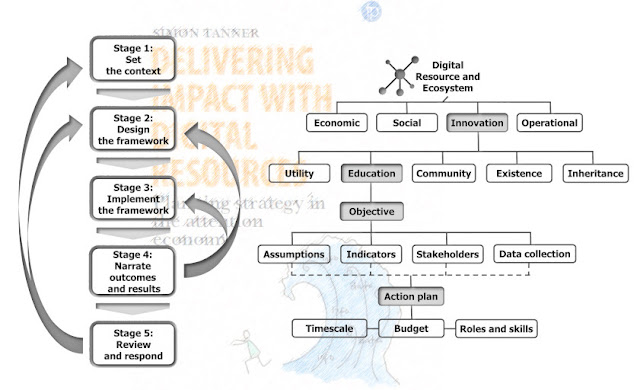
BVI Model Overview of the Stages


BVI Model Process


This report is an output from an Arcadia funded research project. I gratefully acknowledge the support and vision of the Arcadia Fund and all the people there who helped this activity at every stage. Full details of Arcadia’s grants are available at the website here: http://www.arcadiafund.org.uk/


Citing the BVI Model report

Tanner, S. (2012) Measuring the Impact of Digital Resources: The Balanced Value Impact Model. King’s College London, October 2012. Available at: www.kdcs.kcl.ac.uk/innovation/impact.html

Friday, 10 August 2012

Midnight Running to Explore Cultural Value

On the 18th August I will be participating in probably the most intriguing midnight work I have ever done. I will be joining the Midnight Runners to explore my Modes of Cultural Value (explained in this previous blog post Cultural Value and Impact). I am working with Inua Ellams (Writer/graphic arts/poet/performer) and also David Slater (Director at Entelechy Arts) within the Creative Futures programme at Kings Cultural Institute.

What is the Midnight Run?

In the Midnight motto, ‘star’ can be taken literally, or as a metaphor for art, artists, experiences and the people in the shadow of the city, in which case it takes on a beauty and importance:

The Midnight Run //
Cause we can't see stars for fumes
we turn to smashed glass, believing
shards shine like constellations do.

Inua Ellams x

http://themnr.com/

The Midnight Run is a journey of discovery through London at night over 12 hours, from 6pm to 6am. It is the creative brainchild of Inua Ellams (a Word & Graphic artist), he describes it's conception here:
One autumn evening in 2005, a friend and I lost patience waiting for a bus and on a whim decided to walk the bus’s route. Six hours later we’d drifted across London from Battersea to Chelsea, Victoria, Vauxhall, the west end into the small hours of the morning. Surprised at how fresh and energised we felt, marvelling at the deserted streets of the city, without its hustle and bustle: the peace and tranquility of a deserted Oxford street, being able to glance up without fear of hitting or being hit by something, discovering beautiful side streets, small courtyards, parks, I recreated it in summer the following year, for 12 hours, from 6pm to 6 am and The Midnight Run was born.

and it is very well described by Sana A. Malik a past Midnight Runner:

Ellams has been running the Midnight Run in different UK cities for over five years now, covering different well-known landmarks through a run with the wind nighttime excursion. This is the stuff of urban psychology, perhaps even urban mythology. Except we’re not chasing ghosts here, simply a lost side to a city we come to be strangers with in the day. We’re getting to know it at night, when all its secrets are out and it is at its most exposed. And the taste test seems to work. Soon, our own inhibitions so ready for battle during rush hour on the tube begin to subside. And with them, our ability to play – to interact - and to be in a London that isn’t quite cold and isolated.

Films made of recent Midnight Runs are available here: http://vimeo.com/inuaellams/videos

How will we explore Cultural Value?

I got involved and met Inua and David because of the Creative intersections: artist as citizen and intermediary project, brilliantly led by Jocelyn Cunningham at the Royal Society of Arts, within the Creative Futures programme at Kings Cultural Institute.

David Slater, is Director of Entelechy Arts. Entelechy works with people of all ages, abilities and backgrounds to produce high quality theatre, music, dance and video events and performances. Later in September, David and Inua will co-curate a mini-Midnight Run for participants from the Entlechy community.


The artist as citizen and intermediary pilot project sets out to explore a partnership model of mutual enquiry bringing together artists and academics to work alongside each other and the RSA in practical mini-experiments. The questions being raised through these experiments will explore the diverse role of the artist in present day society.

Artist as citizen and intermediary runs from April 2012 to March 2013. Funded by HEIF through the Creative Futures programme at Kings Cultural Institute this project is a collaboration between the RSA, Kings College London and the socially engaged arts community. It forms part of a larger body of work at the RSA under the banner of ‘arts and society’ which explores the arts through the frames of social change, value and place-making.

Cultural Value Experimentation


We seek to curate two journeys across the city. This one for Inua’s established and expanding group of Midnight Runners; and later in September, a mini-one for a group of Entelechy’s more physically frail and isolated elders curated by David and Inua. Two journeys pausing, passing and playing by iconic places and spaces in the city.

The Runs will be given a context and an experimental basis by exploring the themes raised in my framework of five Modes of Cultural Value. We will seek to explore the resonance of specific sites along the journey to those Modes and whether other values emerge as well. The experiment will take the form of qualitative data gathering during the Midnight Runs by me as the Runs pass into the zone of a space or building that epitomises either literally or metaphorically a particular mode of cultural value.

Data gathering will be done through group exercises/games, questioning individual participants informally and by observation. Participants will be offered the chance to add new modes of cultural value to those offered here. I am excited by the opportunity to compare and contrast these participant groups and to ask whether this method of data collection is useful and significant. I understand we have a somewhat random collection of people, that the statistical significance will be low but this form of pilot allows for an element of play, taking a chance, trying something new and experimenting with active participative research methods.

There will also be artists videos created and other creative activities during the Runs will also provide further evidence to be assessed at a later date and used as exemplars.

We will publish more here as things happen and on Inua and David's sites.

Friday, 20 July 2012

Cultural Value and Impact

In this blog posting I wish to discuss cultural value a little bit and how it can fit into an impact assessment. It is is a follow up posting to this: A New Approach to Measuring Impact for Digitised Resources: do they change people’s lives?
Copyright: Jonas Raeber, Switzerland
This is a work in progress - more my notes and queries. I wanted most to get this out there and to get your views, your inputs and your insights. Please comment, your thoughts are valued!

My research funded by Arcadia will be published in Open Access modes in September 2012. I have developed a model for Impact Assessment for digital resources relevant to cultural, heritage and education called the Balanced Value Model. A central aspect to this is cultural value and this posting will explore some aspects of this theme.

The Balanced Value Model is intended to aid the thinking and decision making of those wishing to engage in Impact Assessment (IA). It also acts as a guide through the process of IA to enable the core values most appropriate to the assessment to be brought to the fore and given a balanced consideration when evaluating outcomes.

The Value of Perspective

Considering a beneficial change in someone’s life or life opportunity means that the intervention in their life through engagement with a digital resource may deliver benefits that are at heart advantageous from many perspectives such as:
  • Educating and learning
  • Engaging and increasing knowledge
  • Economic and generating wealth
  • Health and wellbeing
  • Social and community cohesion
  • Environmental and sustaining
  • Political and democratising
  • Technological and innovating
  • Entertainment and participation
  • Equality and equity
There are other perspectives one could consider of course. The UK Government has recently carried out the Life Opportunities Survey, a major social survey to explore disability in terms of the social barriers to participation. What the list above demonstrates is that the modes of benefit and value to be measured for impact assessment are many and varied in their roots and their perspectives.

One persons benefit could be another person’s deficit. For instance, when I recently described the 20 million plus online visitors to the Codex Siniaticus, one of the most important books in the world, an impact assessment expert replied (with tongue firmly in cheek) that economically it could be argued the nation was in deficit as those 20 million plus viewers were not shopping online or engaging in tangible economic activity when they were viewing this treasure. Impact Assessment has at its heart the need for perspective to be recognised and taken into consideration.

We also live in an environment where Governmental measures, particularly those of DCMS in the UK, default to quantitative performance indicators in terms of public value and accountability. Therefore, there remains a challenge to where very basic metrics and monetary value remain pre-eminent as proxies for qualitative experiences.

Dave O’Brien (who was an AHRC/ESRC Placement Fellow with the DCMS in 2010) wrestles with the conundrum of how the cultural sector proves its value in a way that can be understood by decision makers in his recent report:Measuring the value of culture: a report to the Department for Culture Media and Sport. He comes firmly to the view that value is the key phrase but has to be viewed through the lens of the UK Treasury’s Green Book which stresses the need for Cost Benefit Analysis (CBA) to guide government decisions.
The cultural sector is a rich, mixed economy, of large organisations with international horizons and commercial aims, through to amateur institutions with a more local focus. However no matter what the size or outlook of an organisation, or its relationship with central government...  the importance of understanding the framework used for central government decisions cannot be overstated. (David O'Brien)

There are thus a lot of competing opinions on how best to justify and thus fund activity in the future. Particularly digital resources and collections now have an uphill struggle for funding with a backdrop of £100 million expenditure over 15 years and a lack of adequate multi-dimensional evidence to demonstrate meaningful change in people’s lives or opportunity.

One way to achieve this would be via cultural economics, as supported by Bakhshi, Freeman and Hitchen in their 2009 paper Measuring intrinsic value – how to stop worrying and love economics:
Cultural economics, potentially, can in fact provide precisely those guarantees required, by the critics of instrumentalism, that choices about arts funding should be freed from the prejudices which arise if intrinsic value is neglected. ‘Good’ economics – the rigorous application of cultural economics – can thus reverse a traditional but obstructive line-up which pits economists, cast as architects of instrumentalism and all things philistine, against arts leaders, cast as beleaguered defendants of intrinsic value and all things aesthetic.

We must, in my opinion, grasp issues of cultural economics but also go further. If the community of culture, heritage and the Academy harness ourselves solely to the economic measures of Contingent Valuation or Willingness to Pay models for instance then we would be measuring only one vector of a multi-variant environment of value and life changing impact. That sole focus on economic value would help Government bodies to make decisions but I question how helpful to the beneficial stakeholders or the organisational decision makers this would prove.

I suggest that defining modes of value for digital culture that are not solely economically driven but which do contain indicators of value that can be measured and can demonstrate change are important to consider the impact particularly of digital resources.

I would suggest, for the purposes of aiding and supporting the Balanced Value Model of Impact Assessment, that a new 5 Modes of Cultural Value for Digital Resources should be established as follows:


5 Modes of Cultural Value for digital resources


Utility Value
  • People value the utility of enjoying the digital resources now or sometime in the future.
    Existence and/or Prestige Value
    • People derive value and benefit from knowing that a digital resource is cherished by persons living inside and outside their community. This value exists whether the resource is personally used or not.
      Education Value
      • People are aware that digital resources contributes to their own or to other people’s sense of culture, education, knowledge and heritage and therefore value it.
        Community Value
        • People benefit from the experience of being part of a community that is afforded by the digital resource.
          Bequest Value
          • People derive satisfaction from the fact that their descendents and other members of the community will in the future be able to enjoy a digital resource if they so choose.

          Note: I refer to Modes of Cultural Value as these are not absolute cultural values. Modes relates thus to a way or manner in which the cultural value occurs or is experienced, expressed, or achieved most frequently in a given set of data.

          The importance of these Modes of Cultural Value is to provide context at the design and evaluation of outcomes stages for Impact Assessment and thus ensure that measures consider not just direct benefits but also intangible value. It helps to position the organisation, to understand the stakeholder benefits and to clarify the key drivers for the IA. Digital resources and collections can be valued even by those not actively using them, they can have benefits that reflect back upon the creators and users and their communities and they have benefits that extend well into the future to the next generation.

          Within the Balanced Value Model the values are treated as major components of the Value Drivers  that define why an organisation or their stakeholders wish to understand the Impact of a digital resource. Of course, out of context in this blog post, that wont make a huge amount of sense, but is a sneak peek of where the Model will be going when published in September...

          Thursday, 7 June 2012

          Are online aliases ever justified in academic debate?


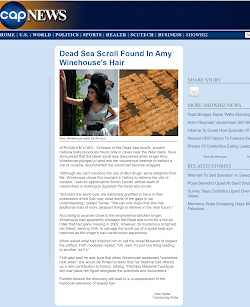
          When a sock puppet comes calling, academic excellence is put at risk. My piece published in the Guardian Higher Education Network on the 7th June 2012.

          It was interesting to see all the sock puppets who came out to play in the comments section of the piece. Seems like the Golb case is a cause célèbre for many out there. I would have responded with some factual corrections but I was suffering from chicken pox at the time this was published and thus hadn't the energy to get my thoughts online at that time.

          So for the record:

          1. I am not part of a Dead Sea Scroll (DSS) conspiracy or otherwise against Golb. He is merely the best publicised sock puppet in academia and I wanted to write about sock puppets. I did lead the DSS pilot digitisation with other technical experts such as Greg Bearman, Julia Craig-McFeeley and Tom Lianza. I have not had involvement for the last two years or so with anything DSS related since Google got involved. The peer reviewed paper on the pilot activity is available here (pdf). Greg remains involved with the DSS and is the world's pre-eminent technical brain behind the multi-spectral imaging aspects of the DSS. My role was to lead the pilot team to deliver all the objectives of the pilot and to write the pilot report and fundraising budget/strategy.

          2. I must apologise for two things:

          • I imply Golb has been imprisoned when he is still out on appeal. His charge stands at this moment subject to that appeal, but he hasn't served any prison time.
          • I must also apologise for spelling Lawrence Schiffman's name incorrectly.

          3. The Guardian decided to change the title from my original "When a sock puppet comes calling, academic excellence is put at risk" to the somewhat more accessible but maybe misleading "Are online aliases ever justified..."
          Please note my definition of the problem as "This is not the anonymity we all sometimes seek when online; sock puppetry is about setting up a false identity so the puppeteer can speak falsely while pretending to be another person.... a person using multiple pseudonyms to give a false and biased impression of scholarly debate." I am not opposed to anonymity or online aliases - I am opposed to sock puppets as defined here.


          Despite some of the attack comments and the inevitable controversy of writing anything that includes the DSS I am glad to have written this piece for the Guardian. I feel strongly about a sock puppet in the field of digital humanities and I hope this helps to resolve that issue. I have also received many comments, tweets and messages of support for my perspective from those who can see beyond the DSS exemplar. And there are a couple of blog posts worth mentioning on the issue as well:


          I'd also like to thank those commentators who posted the counter argument and engaged in the debate so actively and with such strong intellectual clarity. I appreciated hearing your voices even if they disagreed with my perspective.

          Update 4th February 2013 as reported in the New York Law Journal:
          The attorney, Raphael Golb, who was convicted in 2010, was found to have impersonated other scholars who disagreed with his father, at one point sending an email purportedly from one of those scholars confessing plagiarism. On appeal, Golb argued his aliases were intended as parody, and were part of an academic debate protected by the First Amendment. The First Department rejected that argument. "Defendant was not prosecuted for the content of any of the emails, but only for giving the false impression that his victims were the actual authors of the emails," the panel wrote in its Jan. 29 unsigned opinion in People v. Golb, 2721/09. "The First Amendment protects the right to criticize another person, but it does not permit anyone to give an intentionally false impression that the source of the message is that other person."